What Is SMILE Pro?
A Surgeon’s Guide to the Procedure, Recovery, and LASIK Comparison
 Dr. Joseph LingRefractive surgeon
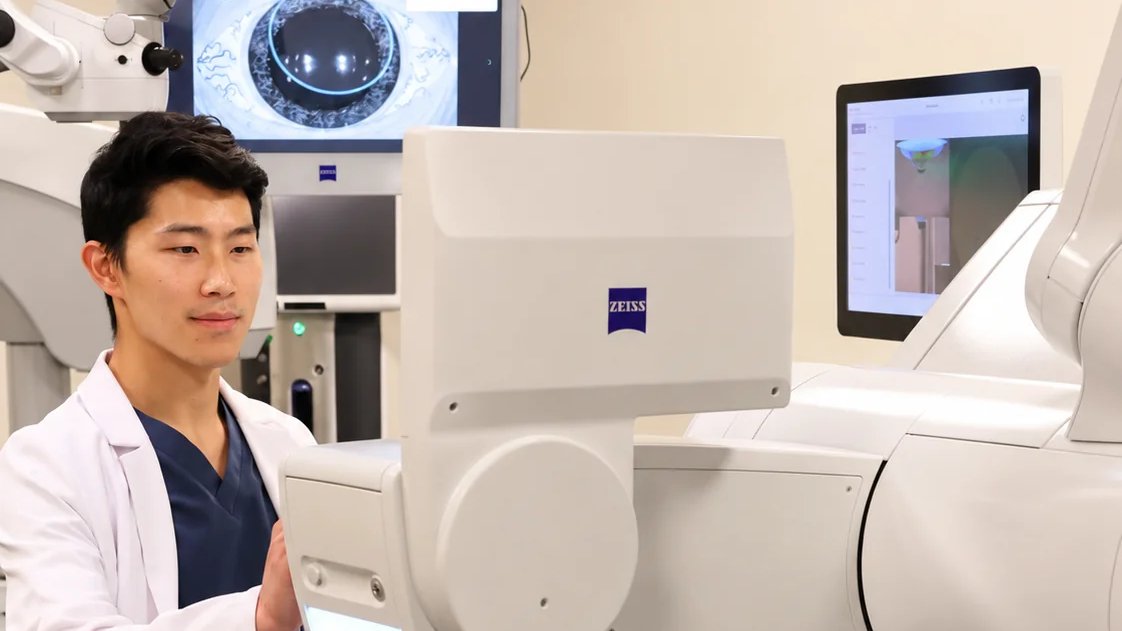
SMILE Pro is a way to correct nearsightedness, with or without astigmatism, using a laser and a small opening in the cornea. It does not require a corneal flap. I perform it at Lucēre Vision on the ZEISS VISUMAX 800, the newer laser platform behind the “Pro” name.
I also know SMILE from the patient’s side: I chose to have it myself. That experience changed how I explain the procedure and its recovery to the people I treat.
How did SMILE become SMILE Pro, and how does it work?
SMILE has been commercially available worldwide since 2011, with clinical studies beginning in 2007. That is over 20 years of experience demonstrating long-term efficacy and safety. SMILE has been available in the United States since 2016. Its approval expanded to include astigmatism in 2018. In 2024, the VISUMAX 800 with SMILE Pro software brought a faster laser and new tools to help the surgeon position the treatment.
The fundamental mechanism by which SMILE Pro works is an ultra-precise femtosecond laser. The laser creates a thin piece of tissue, called a lenticule, inside the cornea. Think of it like a reverse image of your contact lens if you wore one; instead, by removing this contact lens-shaped lenticule, your vision improves permanently. I, the surgeon, then remove the lenticule through a small opening, changing the cornea’s shape so light focuses more clearly.
On the VISUMAX 800, the laser creates that lenticule in under 10 seconds for a typical nearsighted treatment. The platform also helps with centration and with alignment if the eye rotates slightly, which is particularly relevant when correcting astigmatism.
These are useful advances in the delivery of treatment and optimizing outcomes.
Who is a good candidate?
SMILE can treat myopia ranging from -1.00 to -10.00 diopters and astigmatism up to 3.00 diopters. To determine who is a good candidate, we go beyond the general treatment range and focus on the individual, their lifestyle, and anatomical features. We look closely at the most accurate refraction, corneal topography, corneal thickness, corneal contour, ocular surface condition, and internal optics of the eye. We also focus on the individual's lifestyle, recreational and work activities, personal goals, and expectations.
What happens during the procedure?
First, you are made comfortable with numbing eye drops and a small dose of oral sedative. You lie on a bed and look toward a fixation light that is easy to see. I will be right by your side to instruct and control the Visumax 800, which will start the procedure by docking a contact lens over the cornea. The docking helps hold the eye steady while the laser creates the lenticule and a small opening at the edge of the treatment area. After less than 10 seconds of treatment, I then gently separate and remove the lenticule through that opening. There is no flap to lift and no second laser needed to reshape the cornea.
The advanced laser platform delivers precise treatment. As the surgeon, I conduct the lasers, keep the patient comfortable, oversee the treatment, make decisions, and dexterously remove the lenticule. The patient’s role during treatment is simple: follow my guidance and keep looking at the flashing green light. Afterward, you go home to rest while your vision begins to clear.
How is SMILE Pro different from LASIK?
Both procedures reshape the cornea to reduce dependence on glasses or contact lenses. They reach the treatment area differently.
With LASIK, a laser creates a corneal flap. I lift the flap, use an excimer laser to reshape the underlying tissue, and place the flap back. With SMILE Pro, a single laser creates the corneal correction, and I remove the lenticule through a small opening. There is no flap, so there can be no flap-related complication.
Recovery between SMILE and LASIK is similar, allowing most individuals to see without glasses or contact lenses the next day. LASIK offers a wider range of treatment options that can better suit certain prescriptions or eye conditions, such as low myopia (prescription less than -1.50 D), very high astigmatism (more than 4.00 D), or hyperopia. SMILE’s smaller opening may mean fewer dry-eye symptoms for some patients, although dry eye sensitivity can occur after either procedure.
I offer both because the decision depends on the eye in front of me: its prescription, corneal shape and thickness, tear film, and the patient’s visual goals.
What is recovery like? My experience as a patient
When I decided to have SMILE, I had already treated hundreds of happy SMILE patients by then. I was glad to have the experience, because sitting in the patient’s chair felt different from standing beside it as the surgeon.
Before surgery, my prescription was about −3.50 in both eyes. When I sat up afterward, I could already make out the time on a clock across the room. I went home, took a nap, and noticed further improvement that afternoon. I returned to operating the next day without difficulty.
That was my personal recovery, which can differ from person to person. My vision still fluctuated, especially in the mornings, for roughly four to six weeks. I used artificial tears generously. At around eight weeks, I realized I had stopped thinking about my glasses and contacts altogether.
Many patients can resume ordinary activities soon after SMILE Pro, often the next day. Still, vision may be hazy or variable early on and continue to sharpen over the following weeks. I give each patient instructions based on their eyes and their activities.
What side effects should I consider?
During healing, common side effects can include dry eye sensitivity, light sensitivity, and fluctuating or blurry vision. Some people notice glare, halos, or starbursts around lights, particularly at night. These symptoms often improve, but can persist longer for some individuals. The healing process can also affect the final correction, which may fall outside the target range, leaving some need for glasses or further treatment; however, this is very uncommon, and more than 98% of people do not need any glasses or further treatment.
More serious problems, including infection, corneal weakening, or loss of best-corrected vision, are fortunately very rare. SMILE Pro also does not prevent the age-related need for reading glasses. Before recommending surgery, I examine the cornea and ocular surface carefully and discuss the risks that matter for that individual eye.
My own experience made the technology personal. It also reminded me how much it matters to understand the choices before making one. If you are considering SMILE Pro, the next step is a Vision Consultation to determine whether you are a good candidate and to explore what is possible.